⚓ Seafaring
Estimated time to read: 27 minutes
This page of notes contains a lot of overlap with a Mormon Expression podcast episode, titled How to build a transoceanic vessel. I've added a few of my own remarks here and there, but credit where it's due: John Larsen and his cohorts presented a good majority of the content & observations in this page.
In the beginning...
1 Ne 17 is where we find a scriptural account of Nephi being commanded to build a seafaring ship, around 591 BC. Here, I hope to outline some possible problems with this passage.
Consider how many trees it would take to produce a ship. Consider how many sheep it would take to get the fabric for the sails and rope. Consider how any human alive today could build something, anything, from scratch. Not buying supplies from Home Depot, not buying components from another retailer. Imagine you, your hands, and the world, being told to make... a skateboard. Something pedestrian. Could you? Even if you knew how, you would be relying on knowledge, innovation and cooperation from other humans. Can you make a tree into a 2x4 length of wood on your own? In theory, yes, given the tools. Could you do it with no tools? Could anyone do it with no tools?
For Lehi and his family to travel to the promised land from Jerusalem, they necessarily had to travel by sea. What led them to the coast was a Liahona, a compass of curious craftsmanship that just appeared when they woke up one morning. Other precedents for guiding people like, say, Israelites with Moses in the wilderness, had guidance more like pillars of cloud or fire. I guess Lehi gets a compass. A conditional compass, no less. No parallels to 19th century right-hand path magic.
If God can do whatever he wants, he could have just as easily had Lehi's family wake up and find a boat ready to go. Or, better yet, they simply wake up in Peru. Those are non-falsifiable claims. Could have happened, and we would only be able to marvel at how great God is for being both able and willing to do that. Instead, we have a scriptural account of Nephi being commanded to build a boat. This can be read as a faith-promoting story about God giving us accountability to take matters into our own hands. However, we're also given a timeline for when this is purported to have happened, and that is where problems arise.
We need tools!
The setup for this tale is that Lehi's family is wandering in the wilderness for eight years. Presumably that includes the times they had to go back to Jerusalem for plates, then again for wives. I'll repeat again for emphasis, eight years. In my limited experience of camping, for never more than one week at a time, I find myself very skeptical of the utility of their equipment and supplies. The context for Lehi's story is that they have nothing. Either it would have worn down, been destroyed, or simply discarded as dead weight. Did they leave Jerusalem with a pickaxe? If they did, is it in usable condition after eight years? Wouldn't someone by year five have thought "what am I hauling this around for?" Am I safe to assume that they didn't expect to need a pickaxe at this promised land that God is leading them to? Did God warn Lehi to pack one ahead of time? Is that a detail from the 116 pages?
All they know is that Lehi is being led to a promised land. I'll assume that in 600 BC, Jaffa (the location of modern-day Tel Aviv) had enough local renown for Lehi to at least know that it's a coastal settlement. Since Lehi isn't told at the outset to travel northwest, I imagine that the family expected that the promised land wouldn't require seafaring, but that they could simply walk to it provided they had divine guidance. Traveling by foot to Jaffa from Jerusalem would be around 16 hours of walking; I wouldn't expect to do that in one day with a caravan, but I imagine it could be done in under one week.
Fast forward several years, they get to a land which is not the promised land, and they call it Bountiful "because of its much fruit and also wild honey; and all these things were prepared of the Lord that we might not perish." After being in Bountiful for several days, Nephi is told to build a ship. Verse 9 is important:
9 And I said: Lord, whither shall I go that I may find ore to molten, that I may make tools to construct the ship after the manner which thou hast shown unto me?
10 And it came to pass that the Lord told me whither I should go to find ore, that I might make tools.
"Alright," says Nephi. "If I'm to follow this commandment, I need tools. God, tell me where to find materials to make tools."
Nephi wouldn't need to make tools if he had brought tools. Those two verses suggest pretty strongly that Nephi does not have the tools he needs to build a ship. Thus, Nephi is asking where to find ore to make tools. Fortunately for our attention spans, the scriptures don't make an exhaustive list of each tool needed and used. The drawback to that absence is that we're left to speculate on how did Nephi get the ore after God led him to it.
11 And it came to pass that I, Nephi, did make a bellows wherewith to blow the fire, of the skins of beasts; and after I had made a bellows, that I might have wherewith to blow the fire, I did smite two stones together that I might make fire.
16 And it came to pass that I did make tools of the ore which I did molten out of the rock.
It's not explicitly stated what ore this is, but we can rule out some possibilities since it's a transoceanic vessel, to be submerged in saltwater for an extended amount of time. Gold, silver, or copper won't do. Iron will do, though. Can we assume it's iron? It's not likely to be any kind of alloy like bronze. Alloys would add an extra dimension of complication to an already dubious story.
Nephi didn't respond by saying "oh, that's why you had us bring a wagon full of tools from Jerusalem! I was wondering why I'd need smithing tongs, bow saws, pulley blocks & sheaves, and a pickaxe. Wise as ever, Jesus!" Instead, Nephi asserts "I need to create tools that are required to do this job that you asked me to do." So, imagine Nephi on this mountain, and he is told that there is iron here. How is he going to get the iron out of the mountain? I feel pretty confident that at this point Nephi doesn't have any tools. He has a bellows at this point somehow, so that's one item off of the checklist. Nephi knows that he needs tools to build the boat, and we the readers know that he needs tools to get the iron in order to make the tools to build the boat. So... how do you mine iron out of a mountain without tools?
The iron isn't exposed to the elements in a seam, like an exposed vein, since verse 16 explicitly states that Nephi used "the ore which I did molten out of the rock." He also says "molten" back in verse 9. In English, the language to which the Book of Mormon was perfectly translated to, molten means to melt iron. This means that Nephi needs a blast furnace. The iron has to be heat treated.
Metallurgy
Contemporary technology around 591 BC used a type of furnace called a bloomery. It was capable of making iron soft, but not molten. Amateur-grade metallurgy that you or I could reproduce in our own backyard, like simply burning wood for a homemade pizza oven, could reach a range of 500 to 1,000 degrees Fahrenheit. That's almost hot enough to melt aluminum. Nephi likely didn't make aluminum tools. Nephi would need a furnace to get up to 2,000 degrees to make iron soft, and up to 3,000F degrees to make it molten... in 591 BC. The technology to do that would not exist for another 1,500 years, around 1,100 AD (1, 2). For reference, here are some melting points of various metals. Making these ores molten, as verse 16 explicitly states, would require Nephi to be able to implement heat that would be unheard of in that century.
Simply having the blast furnace isn't quite enough, either. Nephi needs fuel to burn. The most useful fuel source in the Sinai Peninsula around 591 BC would be charcoal. That will only get us up to, again, about 1,000 degrees. Humanity couldn't get 3,000 degree furnaces until we started burning coal (not charcoal,) which is not available in the Sinai Peninsula around 590 BC. For the quantities of charcoal they would need, Nephi would have had to deforest aces and acres and acres of woodlands. Nephi's brethren were "desirous that they might not labor", so we could assume that they weren't helping prepare the wood. Who was chopping the wood? Just to make the charcoal, not counting lumber to build the boat itself. Just the fuel for the furnace, Nephi needs inordinate quantities of charcoal to get the furnace hot enough to build the pickaxe that he needs to get the iron out of the mountain in order to make the tools to build a ship. How do you build a hammer when you don't already have a hammer?
Fabricating suitable material
Think back to the earlier mention of building a skateboard from scratch. Milling, assembling, fabricating, etc. all relies on a cumulative buildup of technology. The phrase "standing on the shoulders of giants" comes to mind. Prior technology advancements enable us to do grander things today. We wouldn't be able to create high-resolution OLED screen panels today unless we first had one-bit LCD's on our microwaves and alarm clocks, as an example.
If you are alone in the woods, you don't have a sawmill, nor do you have a supply of nails or screws. Today, a manufacturer can simply buy volumes of nails/screws, so they can focus on the assembly. This is relevant to this Book of Mormon passage because Nephi had to create an entire smithy from nothing. That is not impossible, but is absurdly unlikely given the technology in that century. For every piece of timber with which he's making the ship, he'll ostensibly need nails to fix the wood together. And let's not forget that it can't be just any old species of tree: specific varieties and grades of wood are suitable for seafaring. Your ship's mast can't be just any old tree. You'll need a very long, straight pine tree.
Manufacturing nails after the industrial revolution is trivial to do on a mass-production scale. Doing it by hand in 590 BC would take a prohibitively long duration of time, burning through the forest to fuel the fire to manipulate the iron to make the nails. Don't forget that it's a seafaring ship, Nephi will need thousands of them, and he has to make each individual one by hand (using tongs,) seeing how his brothers were desirous that they might not labor. Is this impossible? No, it's just absurd and unlikely, and at this point it might take Nephi ten years to single-handedly establish his own industry around charcoal and smithing. Did Nephi bring iron tongs from Jerusalem? I assume not, having needed to obtain iron before he could make tools.
Another example of that absurdity is Nephi using bellows for the furnace, be it a bloomery or blast furnace. Did they find wildlife in Bountiful to hunt, skin, and tan leather from? Did they bring sheep with them over the desert for eight years? Did they have a supply of leather on them? Tanning leather isn't something you do over a short span of time. Did they have tannic acid to treat sheepskins to make leather on the go? Didn't they have to replace clothing over the eight year journey in the desert using wool or leather?
Shipwrighting
Shipwrighting is a professional trade in itself. Creating a ship that can withstand storms and rough water is not something you accidentally do. Before the craft of sturdy ships was really reliable, early seafaring was made up of a group of smaller boats bound in an array by ropes for flexibility. Large ships pitch from side to side, and if they're not build properly, they will bend and break. If a ship crests on a large wave and isn't structurally sound enough, it's going to shatter.
Early European seafaring often gets attributed to Vikings, whose raider ships would rely on calmer waters. If things got too rough, they'd simply have to scuttle the ship and wait it out. Creating a Viking longship took upwards of 40,000 hours of work (1, 2.) Viking longships also didn't enter the scene until 8th century CE, maybe 1,300 years after Nephi successfully executes the construction on his first try to cross an ocean. Impossible? No, but it would be an absurd, isolated breakthrough of technology that left absolutely no trace or footprint.
Supplies
Nephi presumably had to build something bigger than a viking longship, based on their stated provisions and the images the church showed me as I grew up in it. (1, 2) The whole family had to be on board, and needed provisions as this journey would take months. This ship is a technological anomaly, no other ports exist anywhere in the world, meaning that even if Nephi had encountered land, docking to restock simply wouldn't be an option. How much volume would you need for provisions just for one passenger?

Did they have 55-gallon drums for drinking water? I should hope not, as watertight barrels came about 250 years later by Celts. (1, 2, 3, 4) Did Nephi also become a competent cooper and make his own barrels to store the water? Water is also notoriously heavy, so bringing months of supply for potable water would probably weigh the ship down enough to render it useless. They could feasibly desalinate the water by distilling it, which technology may have existed? ... On a ship?
Did the land Bountiful have nonperishable food that would last many months? How big of a ship would this have to be to store those provisions for Lehi's whole family, plus all the extra wives they picked up, and children borne in the wilderness? This ship's storerooms would have to be massive! Whatever nonperishable food they brought must not only contain the nutrients to prevent scurvy, but it must not spoil one week in. So... shelf-stable pickles? The provisions listed are "fruits and meat," which are not known for having a long shelf-life. Maybe the abundance of honey was some kind of a preservative. Either that, or Nephi was also able to engineer thermal insulation and refrigeration.
Not only did they have enough food for the crew to survive the journey, but they also had plenty of seeds to plant, having brought those all the way from Jerusalem. Fast forward to their safe and successful journey, when they just... plant 'em all immediately. You know, native crops to the arid climate of Jerusalem will surely thrive in whichever American coast they settled. No mention of holding some back in case of a bad crop season. Those seeds must have been kept fresh and viable for the eleven-year duration of the journey through the desert and build the ship, and kept sealed air-tight through the salty ocean mists. Good to go. Yes, they had enough usable seeds to start an entire civilization. Oh, we didn't mention seeds until now? Yeah, we had 'em, don't worry about it. You need to stop looking at porn.
Construction
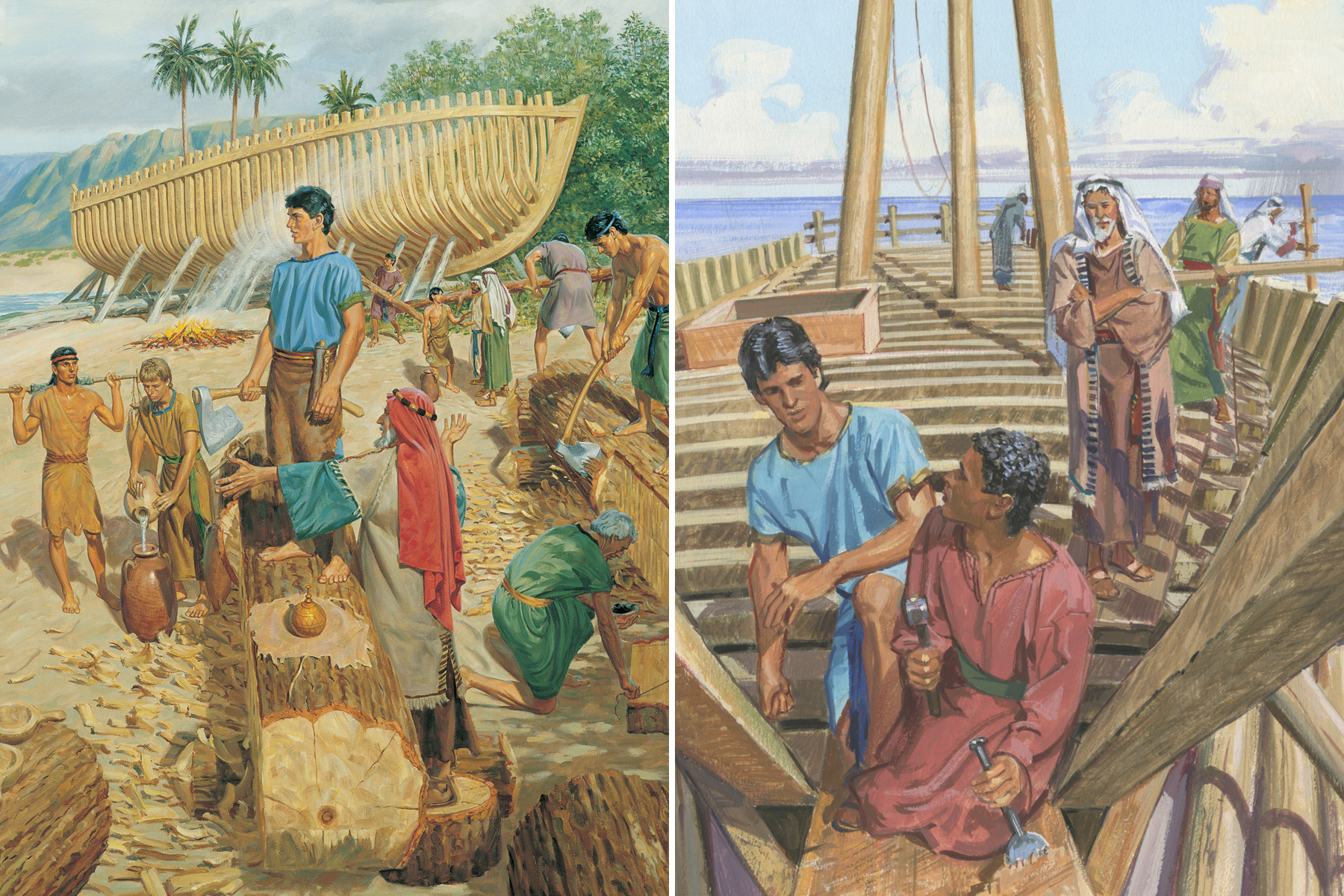
Nephi did explicitly state that "I worked the timbers," and "I finished the ship." Single-handedly? At 12 hours a day, we're now looking at a minimum of (40,000 ÷ 12) ÷ 365 = 9.132 years assuming he already has all the materials handy. Seeing how he needed to obtain ore (material) to create tools, I think it's safe to assume that Nephi did not have all the materials handy.
If you're beginning to question how in the hell did Nephi do all of this by today's understanding of what a ship is, we've got that covered: in 1 Ne 18:2, Nephi was very clear that "I built a ship, but it wasn't done how regular folks build ships, this was from God so it was different so don't worry about it." Having grown up in Jerusalem, he clearly has a vivid frame of reference for how ships were built "after the manner of men," I guess. The "manner of men" shipwrights have to heat-treat and steam the timbers so that they can be bent without breaking. I guess Nephi didn't do that? That would be pretty revolutionary technology, seeing how simply manufacturing a keel for a ship is a profession. Just the keel! Making timber watertight might require tar, resin, or some other kind of malleable sealant. Was that in their provisions in case of a leak?
Without a dry dock, assuming Nephi built the ship on the shore, once it's done he'd need to rely on high tide to come in and lift the ship off the sand and pull it into the water, and hope that scenario doesn't happen even once during the 9+ years it was under construction. Did he make a graving dry dock? You know, digging a big hole in the ground below the waterline for construction, with retractable gates to control the flow of water into the site to lift the ship? Was the dock sheltered from weather and elements? And he showed up with no tools? Did he molten a shovel and use that to keep seawater from seeping through the coastal sand? Or am I expected to believe that he made a slipway with rails or rollers that didn't damage the keel? I guess we won't know, seeing how it isn't "after the manner of men."
Did they have a tiller or a rudder? It could have been a stern-mounted oar that functions as a rudder. If that was the case, it would snap as soon as they hit stormy water. What we think of today as a rudder is attached to the sternpost, the skeleton of the ship, making them much more sturdy. That technology didn't exist for another 1,000 years or so.
Rope
Simply having a floating wooden vessel isn't enough, assuming it was possible to make. We also need ropes. Did they bring numerous spools of rope with them from Jerusalem? The scriptures don't explicitly say. Once out to sea, Nephi was "bound with cords," though it's not explicitly stated as ropes. I'm having a hard time imagining what else they could be. Weaving ropes by hand must be how it was done before ropewalks existed, using machinery to weave and twist them together. That isn't unreasonable to do by hand, though it's going to add many more hours to Nephi's nine-year construction process.
Wool rope isn't good for seafaring as it will stretch out once it gets wet. Oceans are notorious for having lots of water and getting things wet, so that leaves Nephi with plant-based options like hemp or flax. Not only will he need several separate lengths, but ropes for sailing need to not only hold tensile strength when wet, but they need to be of a minimum diameter to keep the ship together. This isn't something to skimp out on, once the winds pick up out in the ocean, you need those ropes to hold fast. Making them thick and sturdy enough isn't a gentle, delicate process. Ships need a lot of strong rope to sail.
By the way, unless this is another time when the Book of Mormon (which was translated perfectly into English) forgot what a word means, 1 Ne 18:9 says they "been driven forth before the wind for the space of many days," verse 22 states that Nephi "did guide the ship, that we sailed again towards the promised land." Having a sail that can be rotated and angled to catch wind will require lots and lots of rope.
Wool
A sail also needs to be a very large sheet of very sturdy material. Longship sails were around 144 square feet (12m x 12m). Transoceanic sails were upwards of 100 square meters. Did Lehi pack one before leaving the seaports of land-locked Jerusalem? Or did they need to build looms and shear thousands of sheep, and then keep it from rotting, keep it away from rodents? By the way, how many sheep would this require?
Cursory internet searching led me to the International Wool Textile Organization, which estimates an average sheep producing 4.5 kg of wool per year, which "is enough to make six sweaters[.]". I don't know what the conversion rate is from sweaters to transoceanic sails, but the Conference of Northern California Handweavers skips the sweater factor and advises the following:
Each 85-square meter sail required upwards of 2000 kilograms of wool, an entire years’ harvest of wool from 2000 sheep. In preparation for spinning, the outer guard hairs had to be separated from the inner wool, taking 3-4 people up to 6 months of labor. Hand spinning the wool into 165,000 meters of yarn consumed another 6 months, and weaving on the warp weighted loom consumed another year or two. For one sail.
Once again, Nephi's brothers were desirous that they might not labor, so assuming Nephi single-handedly did the work of 3-4 vikings, we're looking at four additional years of effort to separate the inner wool, spin it into yarn, then weave it into a sail. This is not counting the time spent shearing two goddamned thousand sheep. How big was their sail? Are they going to need patches for if (or when) the sail tears? Are they going to have a backup sail, necessarily doubling the flock to 4,000 and a minimum of eight years of processing?
The sheep need food and water, though, so they will have to be fenced in and pastured, and require human supervision to tend to the young. Shepherding is a full-time responsibility. Did Lehi bring 4,000 sheep from Jerusalem and herd them along for eight to nine years in the Arabian desert? Or, perhaps the family happened to find sheep along the way, maybe already living in Bountiful. How convenient that would be. At that point, why are we taking these logistical shortcuts so that Nephi could have something for his Instagram reels? Why wouldn't God just poof a sail into existence? And if He were to do that, why bother having the family pause in Bountiful for a decade? Just twinkle them away to Brazil and call it a day!
Maybe I'm just hard-hearted. For all I know, the ship didn't even have a sail... but was still somehow driven by wind. Maybe these are all nitpicky hangups and I need to trust that ships built outside of the "manner of men" is feasible and not the point to focus on.
Navigating
The Jaredites had barges, hopped in, spent a year flipping over in the ocean, and somehow ended up in America. Nephi had better technology, so I suppose if navigation was going to be handled by God, Nephi wouldn't have been given a compass, right? ... But Nephi does have a compass, and it's shown to be critical for the journey. So... is it safe to assume that Lehi & friends needed to use oceanic navigation tools?
To my uneducated eyes there is absolutely no way of knowing where in the world I am, when out at sea. The surface of the ocean has no visual landmarks, just water in every direction. Once nightfall arrives, stars are clearly visible, and could ostensibly be used for navigation to at least know that you haven't veered off course in the last hour or two. The sun predictably rises in the east, and sets in the west. I have now imparted to you all knowledge that I could use to intuit what to do if lost at sea. Maybe Nephi, growing up in ancient Jerusalem, knows more about oceanic navigation than I do, seeing how... you know, ancient Jerusalem was known for its busy seaports.
Verse 9 describes this ship becoming a party boat. God is going to have none of that, particularly if L&L are going to be mean to Nephi. Nevermind that the whole pretense of Lehi's family leaving Jerusalem is to avoid destruction. God just allowed Jerusalem to be besieged by the Neo-Babylonian Empire, later burnt down and its temple destroyed... but stay focused, now, we're not trying to make sense of God influencing the Liahona's functionality, just remember that speaking to Nephi with much rudeness upsets God a lot more than Babylonians desecrating the Temple. Don't think about it.
Lehi has a compass. Curious workmanship. Don't worry about how compasses didn't exist for another 1,700 years, Lehi knew exactly what it was, how to use it, and most fortuitously, Reformed Egyptian™ has a word for it. One of two spindles points "the way whither we should go." After L&L have tied up Nephi with cords (again,) the Liahona stopped working. Since navigating at sea is surely more complicated than I realize, Nephi's brothers "knew not whither they should steer the ship." A storm arises, and they "were driven back upon the waters for the space of three days[.]"
This is notorious for a few reasons: among them, God doesn't seem to be influencing the wind at the sails for the ship. If He was, Lehi's family wouldn't need to know "whither they should steer the ship." Even a passing curiosity about "whither they should steer the ship" indicates that Lehi's family is responsible for navigating. God is not steering Lehi's family like he did for the Jaredites' submersibles. They have a buoyant ship and a compass, and have to figure out the rest.
The other notorious observation in this verse is... they only have a compass. How did they know that they were driven back for three days? All they have is a direction, contingent upon obedience. They have no charts, reference points, maps, no way to know once they shape up and the storm clears that they had lost three days of progress. Moreover, did a storm arise and diminish each time Nephi got his feelings hurt? If that happened, I would expect that L&L could at least recognize a pattern. They've seen divine intervention up to this point, and mocking their brother (hypothetically) makes for undesirable sailing conditions.
I don't know just how intense these storms were, but someone on the ship could be justified in thinking "hell yeah, more wind at our backs! Full speed ahead," assuming they have no way to measure velocity over distance, nor have any sense of progress. If they were in doldrums, they could simply be adrift with no wind for three days, I guess. They don't know where the promised land is, how far away it is, or even how fast they're moving. They only know "it's that way." How would they know that the Liahona even stopped working, unless it's being constantly monitored for erratic behavior? If anyone said something unkind to Nephi, did they have to stop everything and evaluate? With no visual landmarks, amid a storm they wouldn't be able to see the stars. Unless it was spinning around indecipherably, the wrong direction could be easily misinterpreted as the right direction. It's a compass. It points in a direction. That's all that anyone could expect a compass to do.
Maybe the second spindle was the "obedience" meter so you know that the first spindle isn't to be trusted.
Duration
Chapter 17's headings summarize the events as: first, being commanded to build a ship, and... the rest of the chapter is pretty much Nephi preaching a 19th century American protestant sermon, calling them to repentance, and then giving them the Jedi lightning zap. You know, the motivating tool that God uses throughout the scriptures, following an established precedent? All of this is estimated to happen in between 592–591 B.C.
Chapter 18 begins somewhere amid ship construction, as Nephi has to talk about L&L being humbled before finishing the ship in 18:4. They set sail in verse 5, disagreements arise and settle, and after "the space of many days" the people land in 🇺🇸🗽🦅America🦅🗽🇺🇸. They also saw horses standing around in the forest. Or... maybe they weren't horses. This chapter's heading estimates these events to have all taken place from "[a]bout 591–589 B.C.." We've got a four year span of time from "commanded to build a ship" (592 BCE, Ch17) and "landed in the promised land" (589 BCE, Ch18.) No delineation of time, since an uncomfortably high proportion of the verses in these two chapters are about Laman and Lemuel being uncooperative. That's the detail that needed to survive through wars and genocides.
How much of chapter 18 was in the promised land? How much time passed between L&L being coerced into compliance and the ship's completion? We have no way of knowing. Could have been a day or two. The only explicit mention of time passing is many days before Nephi's binding, losing 3 days of progress, and sailing for another many days.
If they were sailing across the Atlantic, they will have run into the gulf stream. Without manual propulsion, they would need true serendipity to sail against ocean currents and not break their mast, nevermind landing on the shoreline. If they came from the Pacific side, the currents could be used to their advantage, but that route across the world would make the journey even longer given the distance to cover.
I guess God is all powerful and can do what He wants, so none of this actually has to make sense in the end.